Impulse response analysis for network models
Tosin Salau & Shahryar Minhas
2026-03-28
Source:vignettes/impulse_response.Rmd
impulse_response.Rmd1 Overview
Impulse response functions (IRFs) measure how a shock to one part of the network propagates through the bilinear dynamics over time. Given the model , we inject a perturbation at time and track a network-level statistic over horizons:
At each horizon we compare a network statistic (density, degree, etc.) computed on the perturbed versus baseline network. The shock is applied once; subsequent horizons show how the estimated dynamics propagate it forward.
2 Fit a well-converged dynamic model
IRFs require a fitted model with time-varying and matrices. We use the Gaussian family for clean interpretation and simulate a 10-actor network with small innovation variances to keep the dynamics stable.
sim = simulate_dynamic_dbn(
  n = 10, p = 1, time = 15,
  sigma2 = 0.3, tauA2 = 0.03, tauB2 = 0.03,
  seed = 6886
)

fit = dbn(
  sim$Z,
  model   = "dynamic",
  family  = "gaussian",
  nscan   = 1000,
  burn    = 500,
  odens   = 2,
  verbose = FALSE
)
Always verify convergence before computing IRFs, since poorly converged chains produce unreliable credible intervals:
check_convergence(fit)
#>   sigma2   tau_A2   tau_B2       g2
#> 319.5975 230.5858 180.6480 355.3089
#>
#> Fraction in 1st window = 0.1
#> Fraction in 2nd window = 0.5
#>
#>  sigma2  tau_A2  tau_B2      g2
#> -1.7963  0.8303 -2.2997 -1.1740
3 Building shock matrices
The build_shock() function creates structured
perturbation matrices. Each type addresses a different counterfactual
question.
m = 10

# shock a single directed edge (actor 1 -> actor 2)
S_edge = build_shock(m, type = "unit_edge", i = 1, j = 2, magnitude = 2)

# shock all outgoing edges from actor 1
S_node = build_shock(m, type = "node_out", i = 1, magnitude = 1)

# uniform shock to all edges
S_dens = build_shock(m, type = "density", magnitude = 0.5)

# custom block shock (e.g., a group-level perturbation)
S_custom = matrix(0, m, m)
S_custom[1:3, 4:6] = 1.0
4 Edge shock: effect on network density
How does shocking a single edge affect overall network connectivity? We add 2 units to the entry and track density (mean of off-diagonal entries) over 5 horizons.
irf_dens = compute_irf(
  fit,
  shock    = S_edge,
  H        = 5,
  t0       = 3,
  stat_fun = dbn::stat_density,
  n_draws  = 100
)

plot(irf_dens, title = "Edge Shock (1->2, +2) -> Network Density")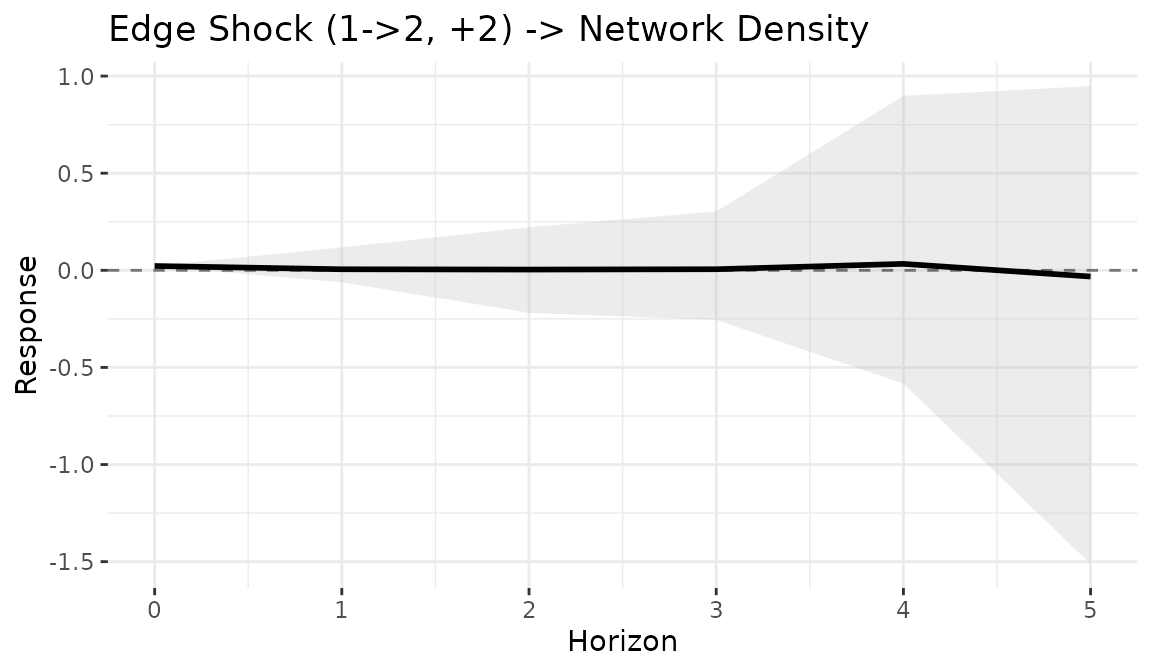
print(irf_dens)
#> Network Impulse Response Function
#> Model: dynamic
#> Statistic: custom_function
#> Shock time: 3
#>
#> Summary:
#>   horizon   mean median    sd   q025  q975    q10   q90
#> 1       0  0.022  0.022 0.000  0.022 0.022  0.022 0.022
#> 2       1  0.005 -0.002 0.046 -0.062 0.118 -0.042 0.062
#> 3       2  0.004  0.000 0.098 -0.219 0.222 -0.104 0.126
#> 4       3  0.006 -0.025 0.246 -0.255 0.303 -0.158 0.126
#> 5       4  0.033  0.021 0.341 -0.584 0.898 -0.303 0.285
#> 6       5 -0.032 -0.002 0.670 -1.512 0.948 -0.716 0.567
At horizon 0, the effect is exact: adding 2 to one off-diagonal cell in a 10-actor network changes density by . At subsequent horizons, credible intervals widen as posterior uncertainty in the transition matrices compounds. The decay rate reflects the spectral properties of the estimated : eigenvalues near unity sustain the perturbation, while values well below unity produce rapid decay.
5 Node shock: effect on out-degree
What happens when an actor increases all outgoing ties at once? The
node_out shock sets all entries in row
(including the self-loop diagonal entry) to the specified magnitude.
irf_deg = compute_irf(
  fit,
  shock    = S_node,
  H        = 5,
  t0       = 3,
  stat_fun = function(X) stat_out_degree(X)[1],
  n_draws  = 100
)

plot(irf_deg, title = "Node-Out Shock (Actor 1, +1) -> Actor 1 Out-Degree")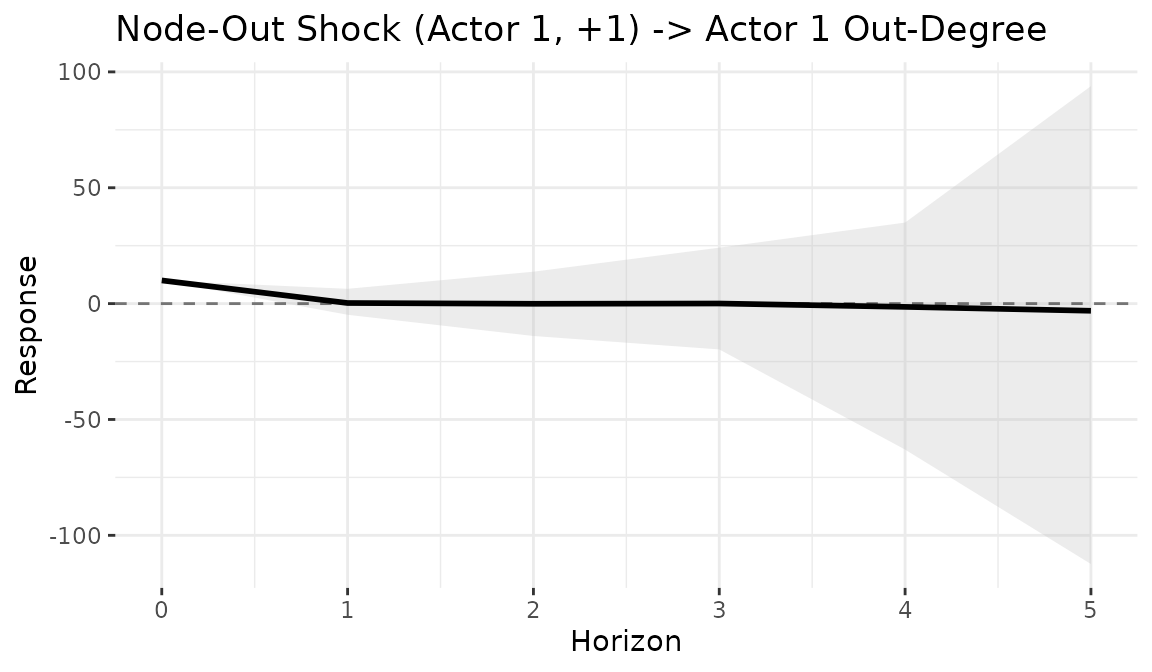
Actor 1’s out-degree jumps by 10 at horizon 0 (the shock sets all 10 entries in row 1, including the diagonal, to magnitude 1). The posterior mean of the effect decays toward zero at subsequent horizons, but the credible intervals widen substantially as posterior uncertainty in the transition matrices compounds across horizons. Wide credible intervals at longer horizons are typical and reflect how estimation uncertainty accumulates in multi-step propagation.
6 Edge shock: effect on reciprocity
Reciprocity is a nonlinear statistic (the correlation between and ). Unlike density, it depends on the baseline network structure, so there is posterior uncertainty even at horizon 0: the same shock produces different reciprocity changes depending on the baseline network, which varies across posterior draws.
irf_recip = compute_irf(
  fit,
  shock    = S_edge,
  H        = 5,
  t0       = 3,
  stat_fun = stat_reciprocity,
  n_draws  = 100
)

plot(irf_recip, title = "Edge Shock (1->2, +2) -> Network Reciprocity")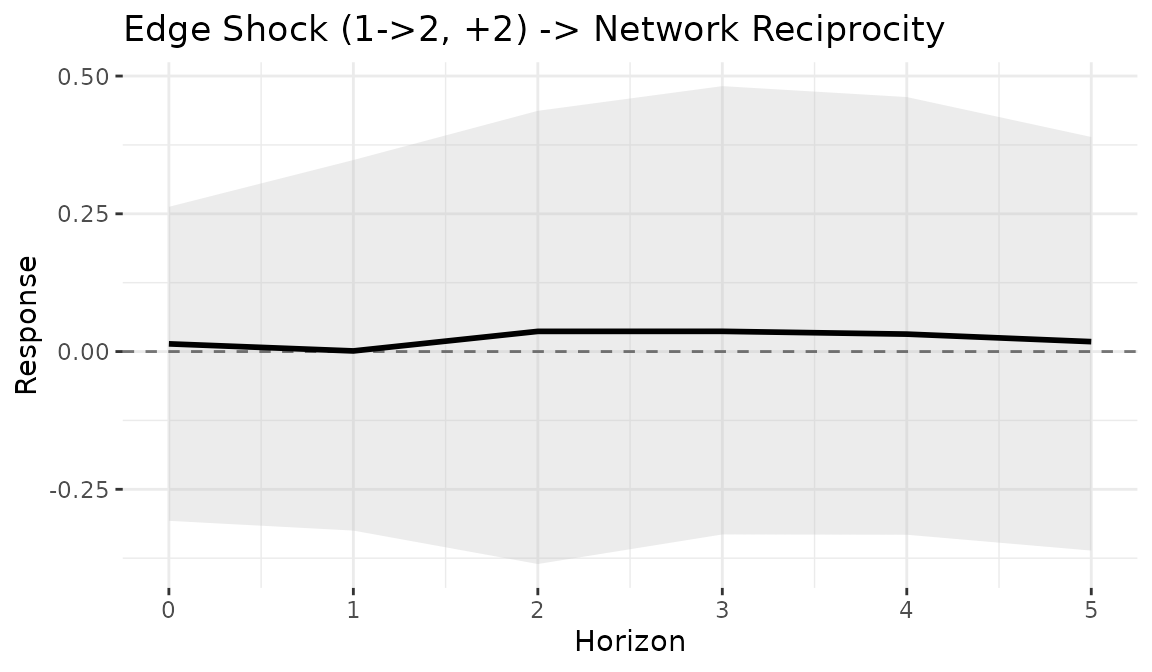
The nonzero credible interval at horizon 0 illustrates this distinction: for linear statistics like density, the horizon-0 effect is a deterministic function of the shock matrix, while for nonlinear statistics it interacts with the posterior distribution of the baseline network.
7 Comparing multiple shocks
Combining IRF results in a single figure allows side-by-side comparison across different shock types and statistics. Each panel uses its own y-axis scale because the statistics are on different scales.
irfs = list(
  "Edge -> Density"     = irf_dens,
  "Node -> Out-Degree"  = irf_deg,
  "Edge -> Recipr."     = irf_recip
)

df_all = do.call(rbind, lapply(names(irfs), function(nm) {
  d = irfs[[nm]]
  data.frame(
    horizon = d$horizon,
    mean    = d$mean,
    q025    = d$q025,
    q975    = d$q975,
    shock   = nm
  )
}))

ggplot(df_all, aes(x = horizon, y = mean)) +
  geom_ribbon(aes(ymin = q025, ymax = q975), alpha = 0.2) +
  geom_line(linewidth = 0.8) +
  geom_hline(yintercept = 0, linetype = "dashed") +
  facet_wrap(~ shock, scales = "free_y") +
  labs(x = "Horizon", y = "IRF", title = "Impulse Response Comparison") +
  theme_bw() +
  theme(
    panel.border = element_blank(),
    strip.background = element_rect(fill = "black", color = "black"),
    strip.text.x = element_text(color = "white", hjust = 0)
  )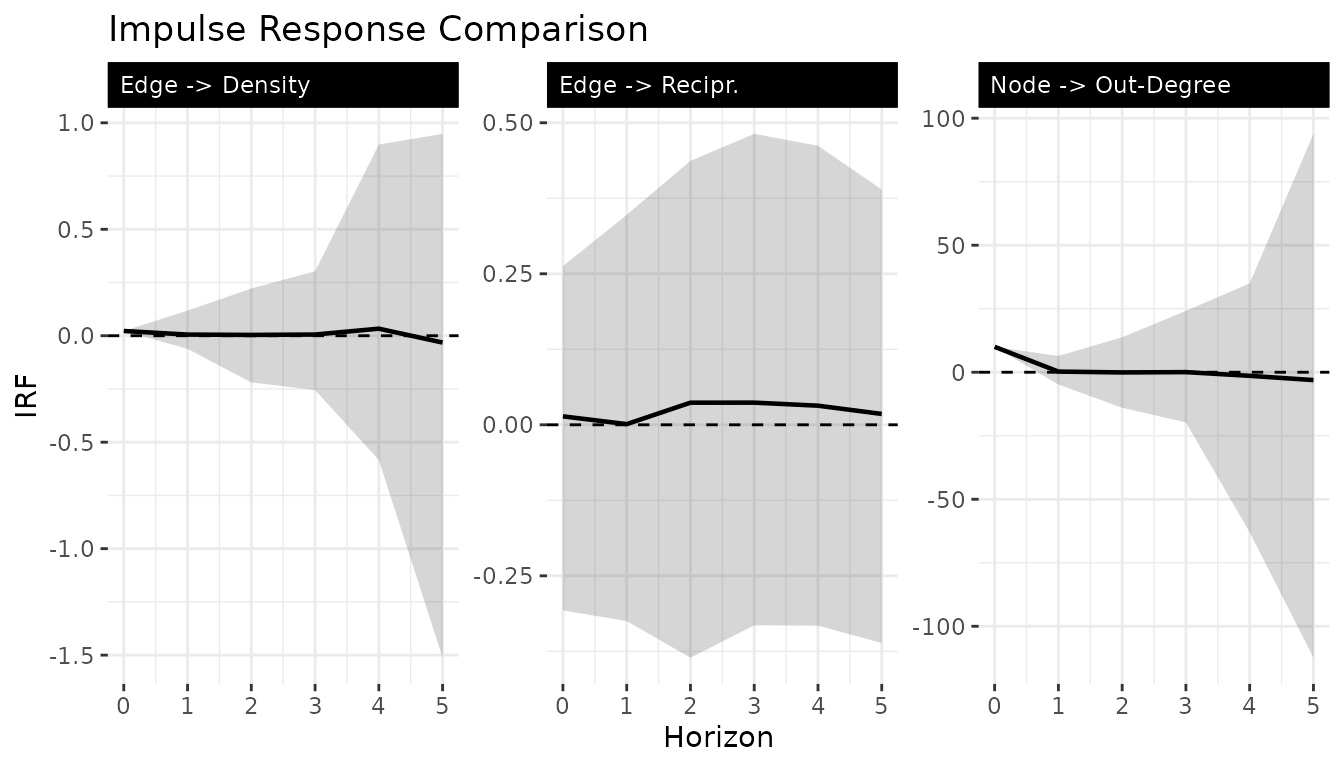
The key pattern to look for across all panels: a clear initial effect that decays toward zero, with credible intervals that widen but do not explode. An expanding credible interval that remains bounded is consistent with a well-identified model; explosive intervals suggest the estimated dynamics are unstable.
8 Interpreting IRFs
Horizon 0 captures the immediate, mechanical consequence of the shock. For linear statistics (density, degree), there is no posterior uncertainty at horizon 0 because the shock is a fixed constant. For nonlinear statistics (reciprocity, transitivity), there is uncertainty even at horizon 0 because the statistic interacts with the baseline network, which varies across posterior draws.
At horizons 1 and beyond, the estimated dynamics propagate the shock forward. Uncertainty widens because the transition matrices and are themselves estimated with posterior noise. The decay rate is governed by the spectral radius of : eigenvalues near unity sustain perturbations, while values well below unity produce rapid decay.
It is important to note that IRFs are counterfactual scenarios that assume the transition dynamics remain invariant to the shock. The credible intervals reflect posterior uncertainty in model parameters, not sampling variability in the observed data.
9 Available network statistics
The stat_fun argument accepts any function that maps a
matrix to a scalar. Built-in statistics include
stat_density() (mean of off-diagonal entries),
stat_out_degree() and stat_in_degree() (row
and column sums), stat_reciprocity() (correlation between
and
),
and stat_transitivity() (clustering coefficient). For
degree-based statistics, wrap to extract a specific actor:
function(X) stat_out_degree(X)[i].
10 Settings for publication
The examples above use moderate settings for vignette build times. For substantive analysis, increase both the model chain length and the number of IRF draws to ensure stable credible intervals:
fit = dbn(Y, model = "dynamic", family = "gaussian",
          nscan = 10000, burn = 5000, odens = 5)

irf = compute_irf(fit, shock = S, H = 10, t0 = 5,
                  stat_fun = dbn::stat_density, n_draws = 500)
11 Next steps
For a complete applied workflow with real data and IRFs, see
vignette("applied_ir"). For piecewise models that compare
pre- and post-regime influence structures, see
vignette("piecewise_dbn").